
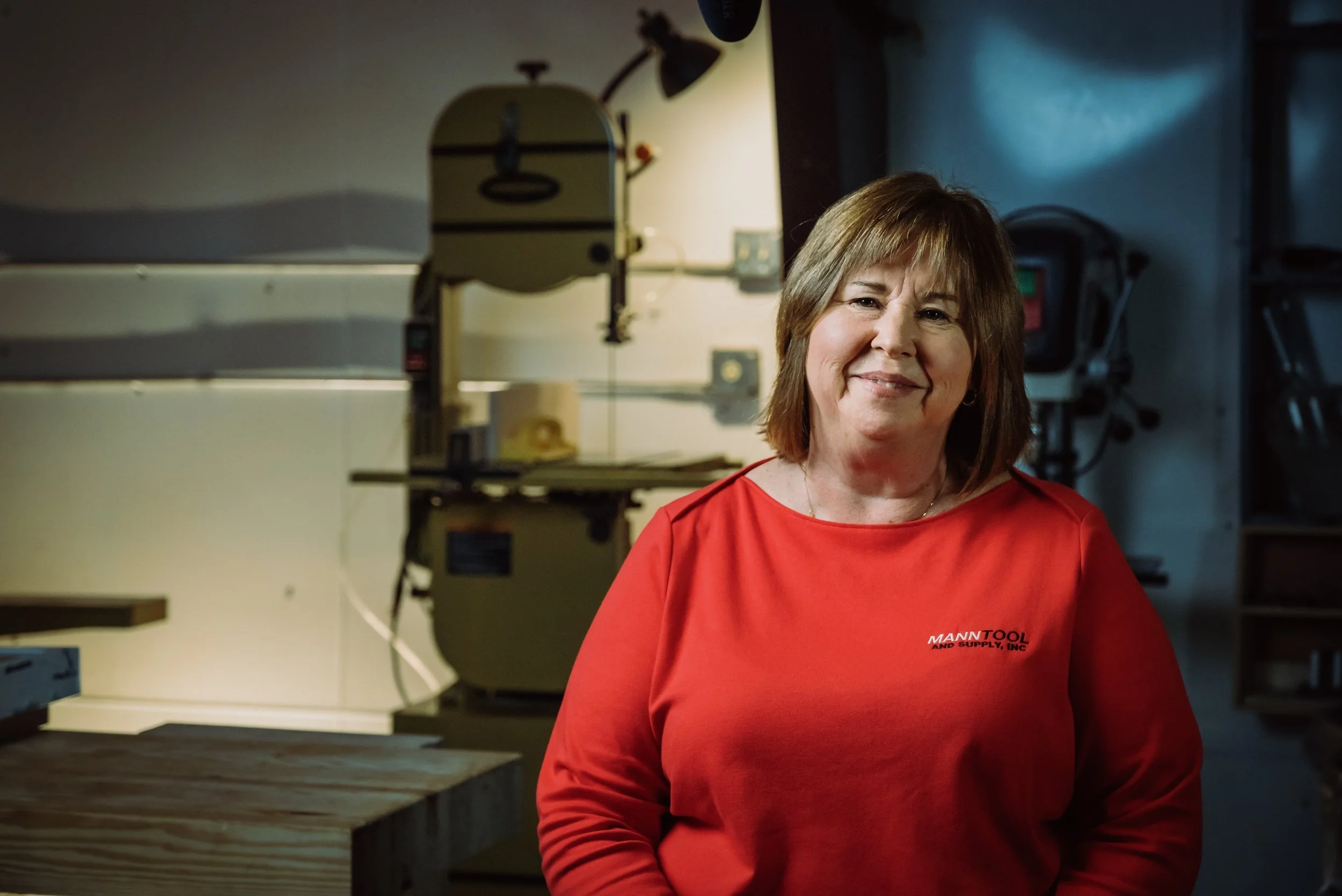
Suzanne Brunnemer is the president of Mann Tool and Supply in West Columbia, South Carolina, a tool and supply company her family has run for three generations. She started counting parts as a kid, became president and majority owner in 2012, and now competes with the big-box stores around her by making sure every customer leaves able to do the job. In this episode of Footnotes, John Barnes talks with her about what a family business really feels like, how an independent shop stands out, and why she built a classroom inside the store. If you run a company between $5 million and $50 million in revenue and you compete against much bigger players, there is a lot here for you.
How does a third-generation owner end up running the family business?
Suzanne began counting parts before she was old enough to draw a paycheck, and she started drawing one at 15. She went to USC to become a band director, kept working summers and holidays, and after a couple of years realized education was not her calling. She finished her first degree at Midlands Tech and came into the business full time around 1992, just as desktop computers arrived. She started by producing flyers and promotions, and because the next generation is usually handed the technology, she picked up IT, the ERP software and the marketing, which back then meant newspaper, radio and a little television.
In 2012, after her uncle, who also worked in the business, passed away, her father decided it was time to prepare for the future. Suzanne became president and majority stockholder. Her dad stayed on and tapered off over the years, and he passed away in 2018, one day after working in the store. They had worked side by side for more than 30 years.
"I started counting parts before I was old enough to draw a paycheck."
Suzanne Brunnemer
What is it like to work with your father, your husband and your cousin?
Suzanne says one of the hardest parts of a family business can be competition between generations, but her relationship with her father was collaborative and almost nurturing. She is candid about the trade-offs: the pay is not wonderful, the hours are long, and in a small family business you might sweep the floor, do the accounting and make sales in the same day. Her husband and a cousin work in the business too.
The hardest thing, she says, is separating family from business. The building feels like her home, and the employees who are not related are still her family. She jokes that it is like raising nine kids, and she believes a family-style culture comes with unspoken benefits.
"For me it's all one thing."
Suzanne Brunnemer
How does an independent shop survive surrounded by big-box stores?
Suzanne starts with a laugh, crediting the grace of God on some days, and then with principle: treat people the way you want to be treated. She compares the store to the bar in the old TV show, where everyone knows each other by first name. What truly sets Mann Tool apart is conversation. Many customers are small contractors, one or two people doing a little of everything, and they cannot afford to get to the job site without the right drill bit. So the staff makes sure each customer leaves with enough knowledge to finish the job well.
She calls the extra effort lagniappe, a little something extra. John notes she is the second guest on the show to use the word, after Emile DeFelice of Soda City Market, and that both explain it the same way: an unexpected extra that makes people remember the experience and value it above the dollars and cents.
"It doesn't do us any good to sell you something you can't use."
Suzanne Brunnemer
The customers range from general contractors down to what she calls professional hobbyists, serious do-it-yourselfers who want better tools for their garage or shop. Small subcontractors who fabricate, install, repair and renovate in a single job need a wide range of products, and the goal is to get them as close to a full solution as possible under one roof. The store also has a strong institutional business, serving carpentry and building trades programs in public schools and the Department of Corrections.
Why build a classroom inside a tool store?
When the company moved into its current building in 2001, it already hosted two local interest clubs, the Columbia Woodworkers and the Palmetto Woodturners. The old facility had no dedicated meeting space, so this time they built one, where the clubs bring in regional, national and even international demonstrators. Then the company started teaching from the inside out: it now has four staff members who teach, plus outside instructors. The most popular classes are still for beginners, people brand new to tools who sometimes end up with a lifelong hobby, a therapeutic outlet or a date night.
John points out that it is also smart business, and Suzanne agrees. Anyone who starts building eventually outgrows their first tool and graduates to the next one, and the staff, trained through the company's buying co-op, keeps giving professionals timely, relevant information too. The classroom is not a separate operation, but the company treats it like one and works to make it accessible to as many people as possible.
"It can frankly be a lead generator."
Suzanne Brunnemer, on the classroom
How do you welcome people who feel out of place?
The classroom also hosts classes aimed at women. Suzanne says it is a combination of things: a friend named Anna pushed her to create a more welcoming space, and she takes encouragement from other women in business. She notes that her industry is about 90 percent male and that she grew up in it, so she has never thought twice about reading a tape measure or changing a saw blade. That makes it harder for her to see how intimidating a tool store can feel to others, so she works to promote women in the trades and to help them gain confidence.
She also describes why making something lights people up: you start with a clunk of wood that might be ugly, something starts to happen halfway through, and then you put a finish on it and say, I made that. John adds that the pride of making something both beautiful and useful builds confidence.
"Confidence is probably the biggest thing walking into this classroom."
Suzanne Brunnemer
What this means for your own business
Two lessons stand out for owners. First, an independent company can beat much bigger competitors by giving customers knowledge and attention that a big box will not. Second, Suzanne's ownership changed hands in stages: she became president and majority owner in 2012, while her father stayed involved for six more years. Moving ownership before the previous owner steps back is worth planning on paper, with a clear view of what the business is worth and how the next generation will pay for it. That is the work we do in family business succession planning and business succession planning. If you are thinking about what comes next for your own company, talk to us about your numbers.
Topics in this episode: Family Business · Succession
Read the transcript
Show the full transcript (auto-generated, lightly cleaned; speakers not labeled)
Hey, welcome to another episode of Footnotes. Today we're talking with Suzanne Brunnemer, who is the president of Mann Tool and Supply here in West Columbia. This is a great episode because we talk about family, and business, and family business. We also talk about how she's managed to have a business that thrives in a world of big-box stores, with personal service. She does it differently, and I can't wait for you to hear more. Next on Footnotes.
Well, Suzanne, thank you for having us here at Mann Tool and Supply. We're with Suzanne Brunnemer, who's the president of Mann Tool and Supply here in West Columbia, and we're actually sitting in one of your classrooms, which I think we'll talk about in a little bit. But why don't we just start at the beginning. You're a multi-generational company, so how did you get to where you are now?
I started counting parts before I was old enough to draw a paycheck, and I started drawing a paycheck when I was 15. I think minimum wage then was around three dollars and thirteen cents an hour. In the interim I worked summers and holidays while I was in school. I went to USC to be a band director, and I still continued to work my summers and holidays. After a couple of years I just realized that education was not my calling, at least not at that time, and I came back into the business. I ended up finishing my first degree at Midlands Tech and coming in here full time, and that was around 1992. Desktop computers had just become a thing, and I really got my start in desktop publishing, producing flyers and promotions for the store. Usually that next generation is tasked with technology, so some other things rolled up under my responsibilities: IT, implementing whatever ERP software we wanted to go with. On the marketing side back then we used newspaper, a little bit of radio, a little bit of TV, all the traditional marketing tools through the nineties. Basically I just did what needed to be done. I think that's what happens in a small business, even if it's not a family business, but my dad and my uncle allowed me to find my place here. There's nothing here I have not done, there's no role I haven't filled, with the exception of fixing tools. Nobody wants me in the repair shop. I'm pretty good at demolition, but I'm definitely not good at putting things back together.
In 2012, a series of sad events: my uncle, who worked in the business, passed away, and my dad decided, let's get prepared for the future. So in 2012 I became the president and the majority stockholder. My dad stayed on and I continued to be the primary decision maker, with him kind of tapering off. He never really retired, but he passed away in 2018. He was in the store the day before he died, and we had worked side by side every day for 30-plus years. What generation are you in the business? I'm the third generation.
So what's it like, being the third generation, to combine family and all that happens in a family with a paycheck? Oh wow, there's a lot to that. Probably one of the hardest things in a family business can be a kind of competition between competing generations. If you study it sociologically, a father-daughter dynamic is very different from a father-son dynamic, and my dad and I had a very collaborative, almost nurturing relationship in business. Now, I will say the pay is not wonderful and the hours are long. Anybody who has owned or run a business knows that you might be sweeping one day, accounting one day and selling the next, or all in the same day. The wearing of many hats is a little more intense in a small family business, but the dynamic has been great for me. I still have a cousin who works in the business, and my husband works with me, so that's another dynamic that can change the face of a family business. I think probably the hardest thing is separating it. For me it's all one thing. My husband works in the business, my father worked in the business, my grandfather worked in the business. As a woman, family and business are the same thing, and it's very hard for me to separate them. This facility is my home. I consider this my home. The people who work here with me, the ones who aren't related, are still my family. I joke sometimes that it's like raising nine kids. I just think there's a bond, and there are some unspoken benefits that come from working in a familial type of business.
I know yours is not technically an all-family business, but I can tell from talking to you that you treat it like a family, that it feels like family, like home. I think that's what it is for me. Well, I appreciate you saying that. I think we do, but like family, everything's not perfect, and sometimes you have to work things out, just like in a family, as we solve problems for clients and help each other get better.
You've got family, but then you've got the business of the business, this competitive field you're in, where you sell power tools among other things. As we discussed when we set this up, there are lots of places where a person who needs a power tool can buy one, and a lot of people are familiar with the large home stores, the big box, if you will. You guys are not that, and you've not been that for three generations. Talk to us about how in the world a business like this survives. You're in a large metro area, so competitors literally surround this store. How are you still standing? Grace of God some days, is what I chalk that up to. We run this business with principle. We treat people the way we want to be treated. Sometimes we're kind of like the Cheers of tool stores. I just came in from the showroom, and people are throwing up their hands and calling one another by first name, staff and customers, and it has a folksy, relaxed feel when you come in the store. But what I think truly sets us apart is that it doesn't do us any good to sell you something you can't use, or something that's not going to help you get your job done. Especially for the customers who are small contractors, who make their living one or two people out there doing a little bit of everything, they need to work as efficiently as possible. I don't need them coming back and saying this didn't do the job, or I got to the job with a drill but I didn't have a drill bit. If we're not having those conversations and making sure the customer is leaving with enough of our knowledge to have everything they need to do their job, and to do it well, then we haven't done our job. I think that's what sets us apart: imparting that knowledge, giving them a little something extra. Are you familiar with the word lagniappe? I don't use it very often, but it really means a little something extra. Our little something extra is that we care. We want you to be happy and satisfied, and if we have any part in how you feel when you look at your finished project and it's good, I really think that's the best outcome for us as a distributor, to have some impact beyond just putting a tool in your hands.
Fun fact: you're the second guest on Footnotes who's used the word lagniappe. The first time it was used was by Emile DeFelice, who started Soda City Market, among other things. He explained it almost the same way you did, as that unexpected extra that people say, I certainly wasn't expecting it, but not only did I get something from it, it makes me remember the experience and put a higher value on it than just the dollars and cents. I'll say, not to be a skeptic, Suzanne, a lot of companies say that. Talk to us a little more about who your people are. Who are the customers who come into a store like this, knowing there are other ways to acquire these tools?
Well, we serve multiple markets, from the general contractor down through hobbyists, and we call our hobbyists professional hobbyists, serious hobbyists. You don't necessarily need the grade of equipment and even hand tools that we sell, but you might want it. It goes back to that satisfaction: if you buy something cheap in your kitchen, it's no different than buying something cheap for your garage or shop. So there are professional hobbyists, professional do-it-yourselfers, and small subcontractors who really need a wide array of products to get their jobs done, because they may be fabricating, installing, repairing and renovating all in one job. We want to supply that person with as many things as possible, get them as close to a solution as they can get under one roof. I think that's really our bread and butter. Then we have a very strong relationship in the institutional market. We love serving the carpentry and building trades programs in our public schools and the Department of Corrections, so you can see where it runs the gamut. You may have somebody doing the same thing in their garage as somebody else is doing on a job site, as somebody is doing in a classroom, and we want to prepare them all as well as we possibly can to do what they do.
That's a good transition. Even though we video this podcast, if you're listening just to the audio you're not going to see this, but we are sitting in a classroom you built here at your store. Talk to us about the classroom. Why did you do it, and how has it helped you build more of a community? The community aspect is certainly something we wanted to foster when we moved into this building in 2001. We were already hosting two local interest clubs, the Columbia Woodworkers and the Palmetto Woodturners. In our previous facility we didn't really have a dedicated space for people to meet or for us to bring in a demonstrator, so we had to make do with the space inside the store. When we got here we knew one thing we wanted to provide was a dedicated space for the Columbia Woodworkers to bring in their demonstrators and serve their membership by fostering woodworking in the community, and the Palmetto Woodturners the same. These folks bring in regional, national and even international demonstrators to promote their craft in our community. That's one piece of that community. But we also wanted to do something from the inside out, so we started bringing in instructors. It started out very simply. Now we have four people on staff who can teach, we bring in outside instructors, and it's really about getting people started. Our most popular classes to this day continue to be at the beginner level. We're bringing in people who are brand new to tools, brand new to woodworking or crafting or building or making, whatever term you want to use, and some of those folks get so excited that they end up with a lifelong hobby. Some people consider it very therapeutic, some people treat it like a date night. Those are all things we're very proud and excited to provide for the community, and to be greeting somebody ten years down the road who started their passion in our classroom, what more could you want than that ongoing, long-term conversation with somebody who found something they were that interested in and are still doing it years later?
Not to put words in your mouth, but listening to you describe the classroom, it does seem like you're growing your family. You talk about this work family you have, and now you've grown this family in the community. I think one thing that's interesting is that these classes are for beginners. People might think, if I'm not a pro, or I don't have a wood shop full of tools, why would I ever go in there? But it seems like a smart business decision also. Well, frankly it can be a lead generator. We try to include the professional as well as the beginner so they can take it to the next level, because once you start doing anything, and I don't care if it's fishing, I don't care if it's woodturning, there's going to come a point where this boat, or this particular piece of equipment, is not enough to meet my needs. People continue to graduate, hone their skills and broaden their repertoire, layering multiple disciplines within the woodworking umbrella together, and we have to be able to help them along that journey. For the professional, I hear our staff talking all the time to people who are earning a living out in the community building and making, and we're still giving them timely and relevant information because of the way our staff is educated. We're very invested in training, our buying co-op provides all these opportunities, and our staff takes advantage of those. So yes, at the beginner level we're able to provide that, but also at the professional level. It is very hard to bridge that gap, to help people understand that we are here for the public, we are here for the community, not just construction. Start to finish, all skill levels in between.
I've also seen that you offer classes that are more women focused, in other words, it might be all women in the class, and of course this is a woman-owned business. Is that on purpose, or has it just happened that way? It's probably a combination of things. Our friend Anna certainly pushed me to provide a more friendly space for females, and to help promote that, so probably both. I take it for granted because I've always known how to read a tape measure and put a saw blade on. These are things I don't necessarily think about, so I take a lot of encouragement from other women in business in our community, and in my industry, which is 90 percent male. I was brought up that way, so I joke that I was socialized as a man. Sometimes it's harder for me to relate and to create opportunities for women to come in and have a place where they feel welcome, because I've always been one woman with nine male coworkers. Women are only about ten percent of the power tool and fastener industry. So it's grown out of a lot of things, and part of it is my personal growth, finding ways to promote women-oriented events and women in trades. There's so much attention on this right now on social media and in the media in general that we know better than to ignore it. There are so many women makers just in Columbia, it's really amazing, so it only makes sense that we try to help foster that and help women make that leap and gain their confidence, because confidence is probably the biggest thing walking into this classroom. Even for me, to this day, it's intimidating. I didn't grow up making. That's something that's kind of new for me.
I hope that's encouraging to the people listening. You literally own the place and you say it's intimidating to walk in, but you do it anyway. I like the way you describe this educational piece, that it really is about showing people something they did not know how to do, and then they leave knowing how to do it. While that might be smart business, I think the business is almost in spite of the education. From the outside, that sounds like a very conscious choice in your ownership and guiding of the company. Absolutely. From a business standpoint it's not a separate operation, it doesn't have a separate name or anything like that, but we do treat it that way, and we try to make it as easy as possible for people to have access, whether that's access to the equipment or ADA-related access, to make sure as many people as possible are able to come in and have this experience.
Not to get overly philosophical, but what is it about making something that lights people up? Oh gosh. You start with this clunk of wood that could be ugly, and then you get about halfway through and it's like, something's happening here, and then you put a finish on it and it's shining and you say, I made that. It's the same thing if you bake a cake or paint your bathroom. Everybody has a first time for everything. We don't all come into this world knowing, or even being comfortable trying things, but it's that end result. It is that satisfaction that comes with going, these two hands, this mind and a little bit of stuff turned out something beautiful. I was hoping you'd say something like that. That's the fun of an interview: not everything is scripted, in fact none of this is, and you ask questions and you're not sure what's going to come back. You're describing how you make something from a clunk of wood, a couple of tools, some know-how and some trial and error, and all of a sudden it's transformed into something not only beautiful but useful, and I think the pride that comes with that helps build confidence. My slight editorial: I think there's a crisis of confidence in general in our society. As much as I want to chase that rabbit, I'm not going to.
Suzanne, I hope people listening are intrigued by this story. How do they find out about classes, and how do they find out about Mann Tool? What's the best way to walk in the door, so to speak? Ideally we want them to walk in the front door. We try to create a shock-and-awe effect when you walk in, from a visual standpoint, the light and color and power tools. It's pretty awesome. But the easiest way to find us now is online, on our website, where you can see our products, see our class offerings and register. There's a lot of history on there too, and the About Us section tells our story, who we are. The website is probably the easiest first step, and we hope that experience makes you want to know more, because ideally you need to just come see it. Great. Thank you so much for allowing us to film here. It's a neat and visually interesting place, and thanks for sharing the story. I hope a lot of people listen to it, are inspired by it, and sign up for classes and come check you guys out here in West Columbia. Well, sure, I appreciate you coming in, John. All right, thank you.