
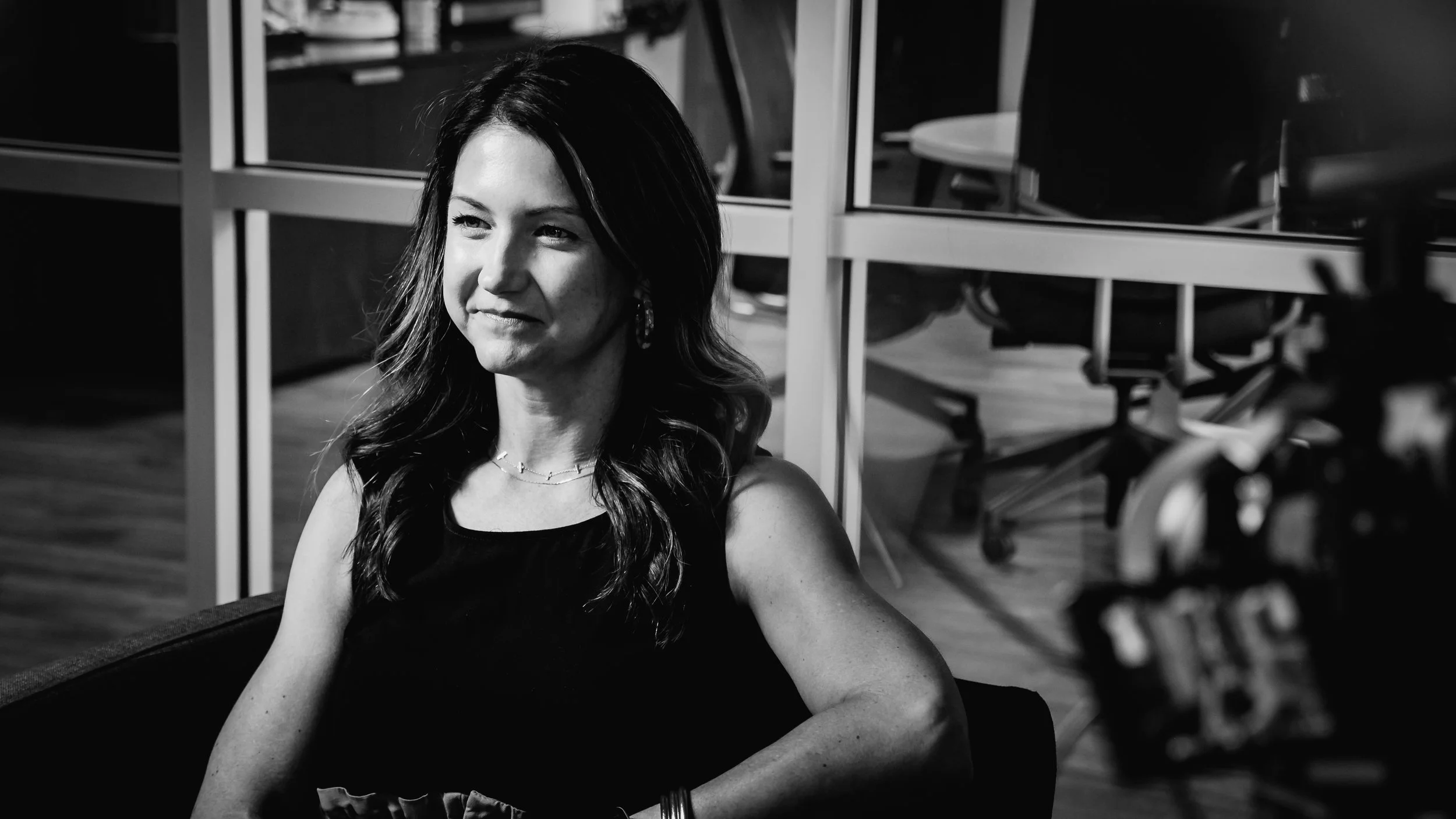
Erin Mehagan is the founder of Livi Lu Lane, a Greenville, South Carolina company that makes intimate apparel, and in this Footnotes episode she tells John Barnes how a personal problem became a product and then a business. She describes herself as a reluctant entrepreneur. The conversation covers what pushed her to start, why making a bra turned out to be far harder than she expected, the five years between the idea and the first sale, how she built a team, and what she hopes her three daughters see. If you run a company between $5 million and $50 million in revenue, or you are the kind of founder who started by solving your own problem, her lessons on manufacturing, suppliers and delegation are worth a listen.
What problem led Erin to start Livi Lu Lane?
Erin says everything about the company comes from a personal need she could not solve with products on the market. After having three daughters and nursing each for a year, she found that her bras no longer fit: they gapped, and when she went down a cup size she lost her shape in her clothes. She considered cosmetic surgery, decided against it, and was left feeling insecure and caught in a negative body-image spiral. After an embarrassing moment leaving a store, she stitched padding into her own bra so it would not happen again. She says she is not a seamstress, but it hit her that women deserve better and that something simple should exist so that women can get dressed and move on with their day.
"I always describe myself as a reluctant entrepreneur."
Erin Mehagan
When she showed her husband the bra and said it should exist, his reaction was to say he loved it and she should do it. She says she appreciated that he did not ask for a business plan or market research in that moment, because the work that came later could have put out the spark.
Why is making a product harder than coming up with the idea?
Erin says she was naive and assumed the hardest part of a business was the idea. She had no manufacturing, design or supply chain background, so she started from zero. Small fashion brands get stuck on minimum order quantities, so she called U.S. companies that work with early-stage brands. One said it had done one underwire bra project and would never do another. She learned that a pair of jeans has roughly eight components, while an underwire bra can have 34 to 36 and requires special equipment. The one company that agreed to try spent almost a year and a half with her and never produced a prototype she could use, and she says she lost a lot of time and money.
How did she find the right partners?
She eventually found a woman who had spent her career in intimates and had started a small agency for emerging brands. That designer turned Erin's idea into a tech pack, the document a manufacturer uses to build a product, much as an architect's plans are used by a contractor. She says she was often Googling unfamiliar terms during calls, and learned that a search for how to start an intimate apparel company will not mention a tech pack.
"You don't know what you don't know."
Erin Mehagan
The designer also connected her with a manufacturer in South America that produced the first production run, which Erin describes as a beta, minimum-viable-product version of the bra.
How long did it take, and what did the pandemic change?
Erin says she had the idea around 2016 and did not release a product for purchase until January 2021. The pandemic arrived in the later part of that stretch. She says the timing had looked perfect for a launch, with her youngest heading to kindergarten, until schools moved to e-learning and she was teaching her children while launching the company for the first time. She also says imposter syndrome is still present, and that she has had to decide for herself what success means, whether that is a large team, an exit, or simply bringing a product to market. Her own measure is reaching and helping women who feel the way she did.
What does she plan to build next?
Erin says she has always seen Livi Lu Lane as a brand women turn to and trust, not a one-product company. After launching with one design in two colors, she is working on a first collection with more sizes and colors, plus a wireless style and a bralette style. She says customers ask for swimwear, and she sees camisoles, tank tops and athletic dresses as natural extensions, all with the signature internal pocket and the option to add shape. She says the company was recently featured on the Today show.
She now works with a production expert who has spent her career with intimates brands, negotiates with manufacturers and checks quality and pricing. Erin's goal for this collection is to find a partner who can grow with the company, not a one-off factory. She also describes the mix of relief and anxiety the first time she handed a task to someone else, and the challenge of passing on the passion and standards that come from being customer number one.
What does she hope her daughters see?
Erin talks about intentionality more than balance. She wants her three daughters to hear a healthy message about body image at home, and to see that it is healthy for a mother to have something she cares about beyond her family. She says they help package orders, and that sometimes the family has to take a back seat for a season while the business needs her.
What this means for your own business
Three lessons stand out for owners who are launching a product or adding a new line. First, long lead times and minimum order quantities tie up cash well before a sale, so build a cash flow forecast that covers the full gap between first spend and first revenue. Second, the right supplier or expert can save more than they cost; Erin lost a year and a half with a partner who lacked the equipment and experience. Third, plan for how you will hand off work as you grow, and decide in advance which standards must not change. That is the work we do in cash flow management and funding strategy. If you are planning a launch or an expansion, talk to us about your numbers.
Topics in this episode: Cashflow · Funding
Read the transcript
Show the full transcript (auto-generated, lightly cleaned; speakers not labeled)
Hey, welcome to another episode of Footnotes. Today we're talking with Erin Mehagan, who's the founder of Livi Lu Lane, a Greenville, South Carolina-based company that makes intimate apparel of all things. What I think you ought to know about Erin is that she was set on fire by a personal problem she had, and rather than staying where she was in frustration and bewilderment, she got her needle and thread and changed the way women will think about intimate apparel, maybe forever. I'm excited for you to hear this conversation.
Erin, thanks for sitting down with us. We're with Erin Mehagan, the founder of Livi Lu Lane, based in Greenville, South Carolina. Why don't we start where most things start and talk about Livi Lu Lane, what you're doing, and a little bit about how you got there?
I always describe myself as a reluctant entrepreneur. I never set out to start my own company. Everything about Livi Lu Lane stems from a personal need and a personal challenge that I was unable to solve with the products available on the market, and that prompted me to create a solution for women who were struggling like I was. I have three girls. I grew three babies in my belly and I nursed each of my girls for a year, and throughout all those years of nursing I joked with my husband that the money we were saving on formula was going straight to my boob job after surgery, because like most women know, your body is going to change, we don't exactly know how, but we anticipate it. Even after I finished nursing I went to a plastic surgeon, and he was terrific, talked everything over and answered all my questions. But ultimately I couldn't go through with it. There was a lot of uncertainty and uneasiness I felt about the surgery. It felt really drastic and permanent and expensive. I was still left with feelings of being really insecure about how I felt about myself and how I looked, and I couldn't shake those feelings. I had a really hard time with my self-confidence and I was in a negative body image spiral I couldn't get out of. That's what ultimately led to the start of Livi Lu Lane.
I know when we had our conversation before this one you brought up the negative body image. Would anyone other than yourself have known how you felt, or was it totally inside?
Absolutely not. I would share self-deprecating humor with friends, but I wasn't as open and honest with them about exactly how I was feeling inside. I was pretty honest with my husband, but he didn't see what I saw. When you're talking about body image and self-confidence, it's such a personal thing, a turmoil inside you, and it's hard to articulate to somebody else because what they see is not necessarily how you feel. Looking at me, most people would wonder how she could have self-confidence issues. I don't struggle with a weight problem, I was able to drop the baby weight that some women struggle with, so it was hard for other people to relate to what I was experiencing, but it was very real to me.
How fast did those feelings turn into the action you took to form Livi Lu Lane?
Once I ruled out plastic surgery, what I was experiencing was that my bras and clothes weren't fitting the way they did before kids. The bras I was used to wearing had big gaps because I had some breast tissue volume loss from pregnancy and nursing, but when I went down a cup size to eliminate the gaps, I lost my shape in my clothing. I was dealing with two issues. I didn't feel like myself in my clothing. Once I ruled out surgery I was trying anything to stop the gap and make myself feel better. I didn't know what I was going to do long term, but I found these things you would typically sew into a prom dress or wedding dress if you didn't want to wear a bra, and I was stuffing them into my bra, like a middle school or high school situation. One day I was walking out of Target and one was sticking out of my tank top, and I was absolutely mortified. I didn't know how long it had been like that. I was thankful I wasn't with friends or anyone who knew me, but it was a horrible feeling and something I never wanted to happen again. So I went home and I Frankenstein-stitched it into my bra so it wouldn't fall out. I'm not a seamstress, I don't have any sewing talent whatsoever, but I just tried to make sure that experience would not happen again. Literally one day it hit me: it shouldn't be like this. Women deserve better. I shouldn't have to go through this endless search for a solution, I shouldn't have this experience at Target where I'm completely embarrassed. There should be something out there for women who are struggling like I am, where we can get dressed, move on with our day and not think about it. Women are so important to our workplaces, communities, families and homes, and I felt I was wasting time and energy feeling this way. If there was a simple solution so I could just get dressed and move on, so I could focus on more important things, that's what I was after. I wanted to skip the part where I didn't feel great about myself and get to the part where I knew I could be myself. It seemed like a simple solution but nothing was available. I remember running to my husband and shaking the bra I had stitched everything into in his face and saying, this should exist, I shouldn't have to do this, I can make something that will help me and can help other women too. He looked at me and said, I love it, do it. He didn't say, let's calm down and put together a business plan and do some market research. He just said I love it, do it.
So you can start a business without a PowerPoint.
I certainly appreciated his enthusiasm and encouragement from the very beginning, because it was what I needed to hear in the moment. I didn't need that light and spark and excitement extinguished by all the work that was absolutely necessary and that I eventually did. But in that moment it was the most beautiful thing he could have said.
A lot of people have a reason like that to do something, and when they put it out to whomever, that's a legitimate make-or-break moment. It sounds like yours was a make moment.
Yes, and I'd say you continually have those moments. Every time I put myself out there, or stand in front of a room full of people, or tell someone about Livi Lu Lane and what I'm building, I get a little anxiety or anticipation about how it will be received. I don't think that ever goes away, at least not for me.
Maybe it's because you were the first customer. I remember the old line, I'm not just the CEO, I'm also a customer. Our firm has had experience with women-founded businesses that started as an intense personal mission, where they were customer number one and did something to solve their own problem. Someone looked over their shoulder and said, hey, what's that, or they used a blog to say, this is what I did to fix my problem, not this is what I'm selling you to fix yours.
But you did turn it into a business, and you make things people can buy. Take us from the point where your husband said, I love it, do it, through the early stages, not where you were sewing them yourself. Most people think that would be so hard, but you did it.
I was incredibly naive when I started, honestly. I thought the hardest part of starting a business was coming up with the idea. I thought that's why people don't start more companies, that no one has that big aha moment. So I have my idea, now we're off to the races. I'm here to tell you that is not exactly how it goes. There are a few more steps. I don't come from a manufacturing background, I don't have any design experience, I don't have any supply chain experience, so I was starting from ground zero. But I felt very strongly about the need, so I blindly marched forward. I contacted a few companies in the U.S. that work with small fashion brands starting out, because that's where a small brand like us gets hung up: the minimum order quantities are so big when you're working with a factory on design and production. I found a few companies that bring that down to a level that's accessible to someone just starting out. The first company I called said, that's really interesting, best of luck to you. The next company said, we've done one underwire bra project and it was so complicated we will never do it again. I said, interesting. What I did not realize was that a pair of jeans typically has around eight different components between the zipper and the seams and the stitching, while an underwire bra can have anywhere between 34 and 36 components. It requires special manufacturing equipment, so there was a whole host of problems I didn't know existed. I did find one company willing to take on our project. They didn't necessarily have experience in intimates, but they were willing to try, and I was grateful. We worked together for almost a year and a half. I spent a lot of time and money and could never get to a prototype I was happy with. They didn't have the experience, the expertise or the equipment to get me to something viable. So I stopped working with them. Fortunately I found a woman who had spent her career in intimates and had just started her own smaller agency to help small brands like us. She was able to take my idea and translate it into a tech pack, which is what a manufacturer needs, similar to the plans an architect designs for a building that a contractor then uses to build it.
You started with naivete and a lack of network, and you had to find these manufacturers and eventually this woman. What was that journey like? Fun, frustrating, all of the above? How long did it take?
All of the above. I came up with the idea for Livi Lu Lane in 2016, somewhere around there, and we didn't launch our first product for people to purchase until January of 2021. It was a very long process of finding somebody who could work with us, then working through the prototype and finding the factory. Luckily the initial designer I worked with had connections with manufacturers she'd worked with before, so she connected us to a manufacturer in South America that could produce our first production run, kind of our beta test MVP version of the bra. You just don't know what you don't know, so I kept calling and kept researching. I thought, I'm not the first person who has tried this, people make products all the time, surely I can find somebody. I kept making phone calls, researching manufacturers and asking a lot of questions when I got somebody on the phone. I just kept going.
It's simple, not necessarily easy: you just kept going. And based on those dates, between 2016 and 2021 we had a little pandemic, which probably affected manufacturers' ability to even take phone calls.
Yes. And the timing went from being absolutely perfect for our launch, with my youngest going off to kindergarten, to doing e-learning, teaching third grade and first grade and launching a business. It was totally unexpected and uncharted waters for a lot of working parents. It was a very challenging time for any established business or career, let alone someone navigating two different areas, trying to be a mom, a teacher and a founder for the first time.
Those are a lot of roles to maintain. Did imposter syndrome come in anywhere?
Does it still come in? Yes, you can put that in present tense. There are constant internal struggles: who do you think you are, who do you think you can do that? You always hear the stories of success and the people who have made it, but for every one of those stories there are a hundred stories of people who tried and failed, and that's always in the back of my mind. How do I make sure I'm on the other side and not part of the failure? That's probably a character flaw I could spend some time delving into. What is success and what is failure? That can be defined in a multitude of ways. Is success an exit? Is it having a team of 10, 20 or 30 people? Or is success just taking an idea and creating a product and bringing it to market? There's a range of possibilities, and it's figuring out what it looks like to you and being comfortable with that.
Has your definition of success for Livi Lu Lane changed since you began?
If there's a crystal ball I'd love to know how the Livi Lu Lane story goes and how it ends, if it ends, or how my involvement goes. But success to me has always been reaching and helping women. I know that feeling and how I felt, and I know that 2016 Erin is still inside me. There are women out there who feel that same way. I've experienced those internal struggles and what they did to me and how they filtered into all other areas of my life, and then I felt how this product helped me, so I know what it can do. That's my North Star: finding those women and showing them there's a solution that could possibly help.
You communicate this personal mission so clearly. A lot of founders raise money and have to give the pitch, but when I heard you talk about your company for the first time, I thought, I've heard this before. Our firm has experience with a couple of female founders with an intense personal story, and I thought this is going to be a runaway success. When you're customer number one, it's different from looking at something from the outside and saying there's a need and I think I can solve it, without having been affected by it. A lot of people focus on how do I make a bra. You went home, grabbed some thread and a needle and fixed it, and that led to, let's make one, and then you talk to people, find another person, and all of a sudden you find out about a tech pack.
I didn't know what that was. Google how to start an intimate apparel company and you won't find a line that says get your tech pack. I'd be on the phone with somebody and they would say acronyms or words and I'd be Googling at the same time, because I didn't want it to appear as though I had no idea what they were talking about. But you don't know what you don't know until you get to the point where you need to know it.
You were recently featured on the Today show, which I'm sure led to orders. Take us a year or two into the future. What would you like to see the company doing, and what's happening now?
I've always seen Livi Lu Lane as much larger than a single product concept. I see it as a brand women turn to and trust, not a one-product company. We started with one design and two colors, and we're working right now on our first collection, which will include more sizes and more colors of this first design, along with two other styles: a wireless style and a bralette style. Even beyond intimates, I want to expand to other products. We get a lot of requests for swimwear, and I see that as a natural growth for Livi Lu Lane. A bathing suit is already a very vulnerable experience for a woman, let alone a woman with self-confidence issues about how her body has changed, so there's an opportunity to create something that helps women there too, along with camisoles, tank tops and athletic dresses. I think there's an opportunity for a wide product portfolio, all with our signature internal pocket and the option to add shape. There's more to come. This is just the beginning.
When we spoke earlier you talked about the manufacturing process. For people who have never created a product, it's not as simple as having a tech pack and a manufacturer. You're talking about other countries, customs, duties, shipping. Did you get a master's in logistics?
I'm working on that, an applied master's in logistics. What has been key for me is finding experts who know that vertical. I'm working with a production expert who has spent her career working with intimates brands. She works with manufacturers, negotiates with them, and ensures quality and pricing. That has been key for this collection: we're not just finding a one-off manufacturer to do our tech pack but a partner who can grow with us and is excited about what we're bringing to the market, not just pushing out a product. She's fantastic and knows when to push, when to back off and what questions to ask, which I didn't have on our first production.
It sounds like you've built, and are building, a team. What is it like when you're the founder doing essentially everything and then other people come alongside as members of your team?
It's both exciting and challenging. I remember the first email I sent to somebody as a handoff, here's something I want you to take and run with. It was a feeling of relief that it was off my plate, but also a huge anxiety of the unknown, because it had all been controlled by me. You're relinquishing some of that control, so then it's about how you provide feedback and how you make sure they're adding value and that it still leads to your vision, lives up to your standards and reflects how you want the brand to be perceived and how women will experience our brand and product. You can't do it all, you absolutely need help, but how do you convey everything to somebody who doesn't have the passion and the mission to reach women? How do you replicate that, bring people into it and create that same energy and excitement, because that's what we're built on?
That can be hard, especially when you're not just a founder but customer number one, with those internal motivations that drove you to get the needle and thread out.
Yes, everything is incredibly personal to me. It's not just a business, it's not just line items and numbers and daily tasks. That makes it ultra challenging too.
Along those lines, maybe we can land it here: you mentioned you have three daughters. A thread in many of our conversations on Footnotes is that people who start businesses or lead organizations doing important things have families. There's a lot of writing on work-life balance. I'm not an adherent of anything balanced, but you and I talked about work-life intentionality, because balance implies the slices of the pie chart are equal. What do you want your girls to see in you as a business leader, and as a person who went from zero to one on a concept and leads a team with a personal mission?
It's pretty wild having three kids, three girls specifically. The strongest influence on a child is their same-sex parent, which adds another layer of pressure. I think about it constantly, from a wide variety of aspects. From the day-to-day: how do they see me looking at myself in the mirror, how do they hear me talking about myself and about my friends. I want the messages they see and hear from me to be healthy and to help create a healthy, positive body image for themselves. I know the messages they're going to hear from the world, but I want the message they get from our house to be that they're going to hear a bunch of stuff, but what matters is how you feel about yourself, and that is the most important thing to drown out the rest of the world. Don't let anybody else tell you how you should feel, how you should look, what you should do or say. You can do anything, be anything, look however you want, but let it be your choice. And I think about what it looks like for a child to watch their mom start a company and watch it grow from its inception. They're really sweet. They thought I was famous from the moment I had a website, so their standards are very low. They love it. They help me package orders, and when they watched the Today show segment and the expert said the founder started the company after she had kids, they all screamed, that's us. I think about how encouraging it could be for them to watch their mom follow her passion, with all the good and bad moments, the long hours, the late nights, the early mornings. They're going to see the whole picture of what starting and growing a business looks like.
Maybe that is the footnote here, that you can invite your children into those things.
Absolutely, and I want them to see that it's okay for moms to have something other than their kids as their whole life and focus. Do I love and support them in every aspect of their lives, 100 percent, like any parent? Yes. But I also think it's important for them to see that whether they choose to be a mom or a wife or a spouse, it's okay for them to have their own thing too, and that's healthy and exciting. It may mean sometimes the family has to take a back seat for a season because this is taking priority, and they may need to help out, but it's important for them to see that it's healthy and exciting to have something you believe in and are passionate about for yourself, no matter what it is.
I think that's great. I think about my own family and other parents we've talked to, and sometimes it comes up that the business provides financially for the family, and also provides something for the founder, a way to apply their talents and put energy into another facet of life. We were probably made to be more multifaceted than we allow ourselves to be. It's interesting talking to people like you, whose business started out as something negative in a way, and you thought, I was made for more, I want to do something about this problem, and I'm probably not the only one, and voila, a business is born. Thank you so much for sitting down and talking about some of these things. I know it wasn't the typical pitch deck presentation, but some of what you covered is important, and there are people out there who needed to hear you say those things.
That's great. Thank you.